
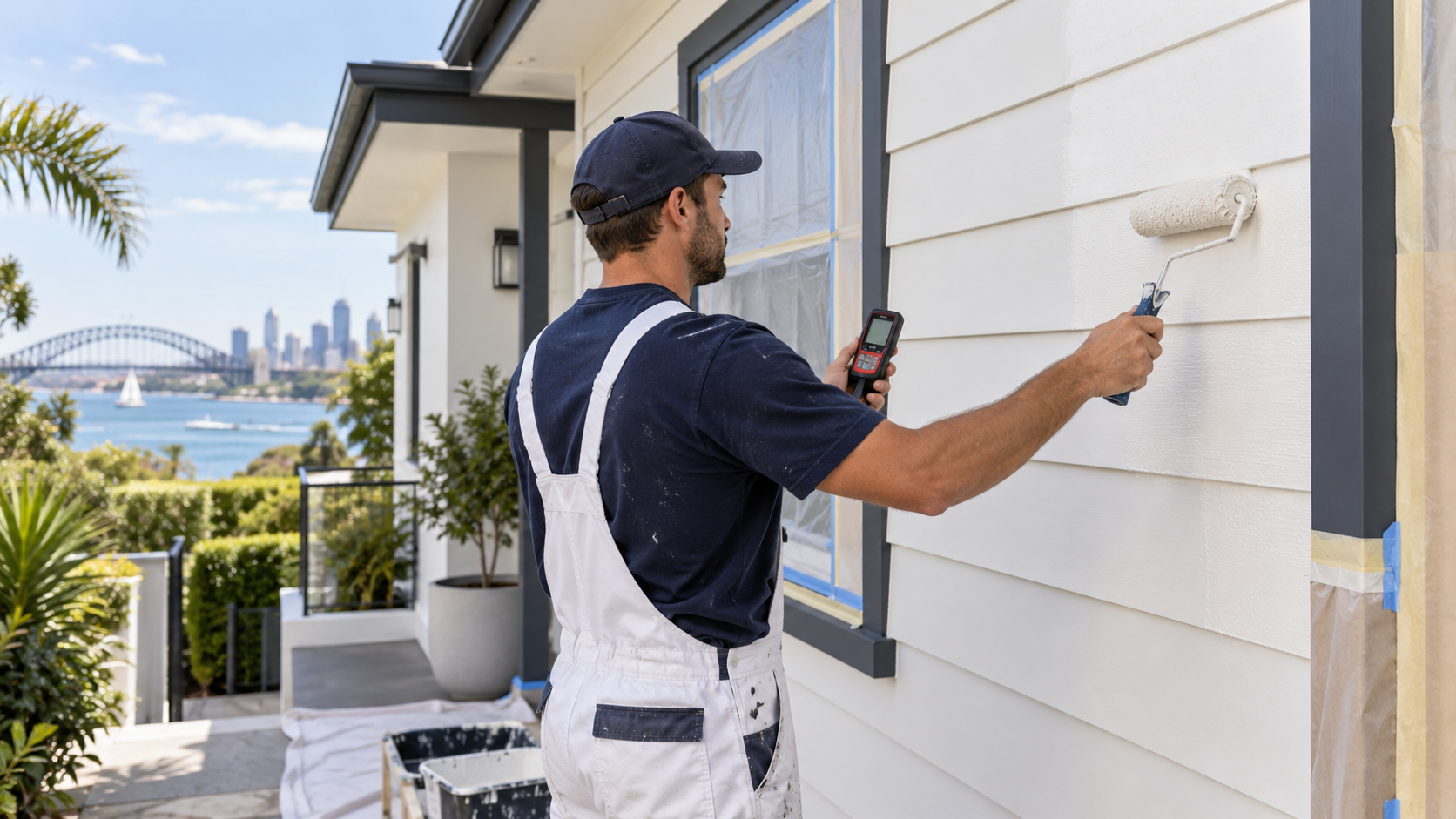
For many common water-based exterior paints, mild conditions between roughly 10°C and 30°C give a practical working range, but exact limits always depend on the specific product and surface temperature. That’s the short version of what the best temperature is for exterior painting, and a useful starting point for planning a job. It’s not the whole story, though.
Air temperature is only one part of the decision. Before you pick up a brush or roller, check surface temperature, relative humidity, chance of rain, overnight dew, direct sunlight, wind and how the weather is expected to behave while the paint dries. Get anyone wrong, and even a good-quality coating can fail early.
In simple terms, the best exterior painting temperature is the product-approved range in which paint can flow, adhere, and dry properly without cold, heat, moisture, or wind disrupting the coating.
What Is the Best Temperature for Exterior Painting?
The best temperature for exterior painting is usually a mild, stable range within the coating manufacturer’s stated limits for the whole application and drying period. For many common exterior products, roughly 10°C to 30°C is a useful planning range, but it isn’t universal.
Rather than relying on one number, check three separate temperatures before you start:
- Current air temperature, measured in the shade near the work area
- Actual surface temperature of the wall, trim, metal or roof
- Forecast temperature during drying, including overnight lows
Exterior Painting Temperature Chart
| Temperature Condition | General Planning Guidance | Main Risk | Required Action |
| Below 5°C | Usually unsuitable | Poor film formation, slow drying and condensation | Postpone unless a coating is specifically approved |
| Approximately 5–10°C | Product-dependent | Paint may remain wet, temperatures may fall further | Check the exact product minimum and overnight forecast |
| Approximately 10–15°C | Often workable for approved products | Slower drying and longer recoat time | Confirm surface temperature and allow extra drying time |
| Approximately 15–25°C | Commonly favourable | Conditions can still change with the sun, wind or humidity | Monitor the surface and forecast |
| Approximately 25–30°C | Often workable | Faster evaporation and reduced working time | Follow shade and application guidance |
| Approximately 30–35°C | Caution required | The surface may be much hotter than the air | Measure the substrate and avoid direct sun |
| Above 35°C | Often unsuitable | Rapid skinning, lap marks, heat stress and poor handling | Postpone or follow the specialist product instructions |
This chart is general guidance. The minimum and maximum limits on the paint’s label or technical data sheet take priority over any general range.
Temperature Measurement Checklist
- Use a reliable thermometer for air temperature, and an infrared or contact thermometer on the surface.
- Check sunny and shaded sections of the same wall separately, since metal, masonry and timber behave differently in the sun.
- Review the forecast for the entire drying period, including the overnight low.
- Allow afternoon sun to move across the façade as the day goes on.
- Don’t assume a cool morning surface will stay suitable all day.
- Stop work if the surface moves outside the approved range.
Product data sheets often say “do not apply below” a certain temperature, or “do not apply when the surface may fall below” that figure; the second matters, since it extends the limit into the drying period, not just application.
How Do Hot and Cold Conditions Affect Exterior Paint?
Cold conditions can slow drying and interfere with film formation, while excessive heat can dry paint too quickly, preventing it from levelling and bonding as intended. Both extremes reduce finish quality, just in different ways.
Film formation is the process by which wet paint settles into a continuous protective coating. When disrupted, the paint may look fine on the surface while remaining weak beneath the surface.
Effects of cold conditions:
- Longer touch-dry time
- Longer recoat intervals
- Greater risk of overnight dew
- Poor coalescence in some water-based coatings
- Trapped moisture
- Reduced adhesion
- Sagging or uneven film
- Delayed curing
- Greater sensitivity to early rain
Effects of hot conditions:
- Paint drying on the brush or roller
- Reduced working time
- Visible lap marks
- Uneven sheen
- Drag during application
- Poor levelling
- Pinholing or bubbling on some surfaces
- Rapid solvent or water loss
- Skinning before the lower layer has settled
- Increased worker heat stress
Weather-Related Paint Problems
| Condition | What May Happen | Practical Response |
| Cold air and cold surface | Paint remains wet longer | Delay work or allow extra drying time |
| Warm air but cold substrate | Condensation or slow film formation | Measure the surface, not only the air |
| Hot surface in direct sun | Paint dries before it can level | Move to a shaded elevation or postpone |
| Hot, dry wind | Brush and roller marks develop quickly | Avoid application outside product guidance |
| Rapid temperature drop | Dew forms on fresh paint | Finish earlier and monitor the dew point |
| Dark metal surface | Surface temperature rises well above air temperature | Measure frequently and avoid peak sun |
| Thick coating in cool weather | Surface dries while the lower layer stays soft | Apply at the specified film thickness |
| Recoating too early | Wrinkling, lifting or trapped moisture | Follow the product-specific recoat time |
Adding water or thinner to compensate for heat should only happen where product instructions specifically permit it; improvised additives can affect how the coating cures and are best avoided.
Can You Paint Outside in Humid or Rainy Weather?
Exterior painting may be possible in moderate humidity when the surface is dry, and conditions remain within product limits. Still, high humidity, rain, fog, and dew can delay drying or damage fresh paint.
Relative humidity describes how much moisture the air contains compared with the maximum it could hold at that temperature. A related measure, the dew point, is the temperature to which air must cool before condensation forms, providing a more consistent picture of actual moisture than relative humidity alone.
There’s no single universal humidity limit. Some products list a maximum relative humidity on their data sheet, while others focus mainly on a dry substrate and protection from rain or condensation during drying.
Humidity Reference Table
| Humidity Condition | Likely Effect | Planning Direction |
| Low humidity with mild temperature | Faster evaporation | Watch for wind and premature drying |
| Moderate humidity | Often manageable | Follow normal drying guidance |
| High humidity | Slower evaporation, longer recoat time | Allow more time and monitor conditions |
| Near-saturated air | High risk of condensation | Postpone painting |
| Morning dew | Wet substrate | Wait until the surface is completely dry |
| Evening dew forecast | Moisture may form on fresh paint | Finish early enough for the required drying period |
| Fog or mist | Adds surface moisture | Do not paint until conditions are clear |
| Rain forecast | Can wash, mark or dull fresh paint | Follow the coating’s rain-free period |
Rain and Dew Checklist
- Check the hourly forecast, including the probability and timing of rain, not the daily summary.
- Check humidity through the drying period, watching for overnight drops that could trigger dew.
- Inspect for condensation before starting, and let washed or damp masonry and timber dry fully first.
- Don’t paint immediately after rain merely because the surface looks dry.
- Protect fresh paint from sprinklers and roof runoff.
- Allow extra time in sheltered or shaded areas, which stay damp longer.
- Stop early enough to avoid evening dew.
Coastal and shaded sites retain moisture longer than exposed, sunny surfaces, so factor location and the forecast into planning.
How Long Should Exterior Paint Dry Before the Weather Changes?
Exterior paint must dry for the rain-free period stated by its manufacturer before rain, dew or falling temperatures arrive. Touch-dry time alone doesn’t mean the coating is ready for weather or another coat.
Drying Stages Explained
- Touch-dry: the surface no longer feels wet to the touch.
- Recoat time: the minimum wait before another coat under stated conditions.
- Rain-ready time: the product-specific period before the coating tolerates rain.
- Hard dry: greater physical resistance, but not necessarily fully cured.
- Full cure: the coating has developed its intended final film properties.
Not every manufacturer uses these terms the same way, so check the specific product’s data sheet rather than assuming.
Drying-Time Interpretation Table
| Technical Data Statement | What It Means | What It Does Not Mean |
| Touch dry in 30 minutes | Surface wetness has reduced under the stated test conditions | Ready for rain or recoating |
| Recoat after two hours | Another coat may be applied after the stated period and conditions | Fully cured |
| Drying figures at 25°C and 50% humidity | Times were established under those conditions | Same drying time in cold or humid weather |
| Rain-ready after a stated period | Coating may tolerate specified rain exposure | Ready for washing or hard wear |
| Fully cured after several days | Final properties develop over a longer period | The area must remain untouched for that entire period |
Planning Timeline
- Check the product’s application limits.
- Calculate preparation time and identify the intended start time.
- Estimate application time for the complete elevation.
- Add the required rain-free drying period, plus extra time for lower temperatures or higher humidity.
- Check the forecast through the final drying window, including evening dew.
- Confirm the timing of the next coat separately.
- Don’t start if the safe window is too short.
As one real-world example, a Wattyl exterior low-sheen technical data sheet advises against application below 5°C or above 35°C during application or drying, with published drying figures quoted at 25°C and 50% humidity, taking longer at lower temperatures or higher humidity. This illustrates how the same phrase can mean different things depending on the conditions, but those figures apply only to that product, so always check the data sheet for the coating you’re using.
How Do You Plan Exterior Painting Around the Forecast?
Plan exterior painting by matching each wall to a stable weather window, and check air temperature, surface temperature, humidity, rain, dew, and wind throughout application and drying.
Forecast-Planning Process
- Check the seven-day outlook for a broad project window, then the detailed hourly forecast the day before.
- Check current observations on the morning of work, and read the exact paint label and technical data sheet.
- Divide the building into elevations and identify when sunlight reaches each wall.
- Start only after dew or washing moisture has dried, painting shaded surfaces before they become hot.
- Avoid chasing direct sunlight around the building.
- Finish with enough drying time before rain or dew, monitoring conditions during the day.
- Recheck the forecast before applying the next coat.
Daily Painting Plan
| Time or Condition | Recommended Check | Possible Action |
| Early morning | Dew, surface moisture and temperature | Wait until the surface is dry and warm enough |
| Mid-morning | Surface temperature and sunlight | Begin on a suitable shaded elevation |
| Midday | Heat, UV and wind | Move to shade or stop if limits are exceeded |
| Afternoon | Changing sun and forecast rain | Work only where drying time remains adequate |
| Late afternoon | Falling temperature and rising humidity | Stop before dew becomes a risk |
| Evening | Overnight minimum and condensation | Protect work and avoid fresh late applications |
| Next morning | Coating condition and moisture | Confirm readiness before recoating |
For Sydney projects, it’s worth checking the Bureau of Meteorology’s hourly forecast and current weather observations rather than relying on a generic weather app icon, since these provide a clearer picture of how conditions are tracking throughout the day.
What Surface Conditions Should You Check Before Painting?
Suitable weather can’t compensate for a dirty, damp, unstable or incompatible surface. Exterior preparation needs to resolve contamination, deterioration and moisture before painting starts, regardless of the forecast.
Check for:
- Dirt, chalking, mould and organic growth
- Loose or flaking paint and unstable previous coatings
- Rust and cracks
- Porous or deteriorated masonry
- Loose ridge capping, damaged flashing or blocked gutters.
- Failed sealants and moisture entry
- Tannin or resin bleed, and salts or efflorescence
- Incompatible coating systems
| Surface | Main Weather Concern | Preparation Focus |
| Timber | Moisture movement and direct sun | Dryness, sanding, priming, and end-grain protection |
| Masonry | Retained moisture and alkalinity | Curing, cleaning, moisture, coating compatibility |
| Fibre cement | Surface contamination and joints | Cleaning, priming and sealant condition |
| Metal | Heat and condensation | Rust removal, compatible primer, surface temperature |
| Previously painted wall | Adhesion of the old system | Remove loose material, test soundness |
| Roof surface | Heat, dew, wind and access | Repairs, cleaning, compatible system, safe work |
Roof repairs, rust treatment, flashing repairs, and cleaning all need to happen before roof painting begins, since weather-related failures on a roof are harder and costlier to fix afterwards. Our roof painting cost guide covers what that typically involves.
DIY or Professional Exterior Painting?
DIY painting may suit accessible, low-level surfaces in stable weather, while high, steep, deteriorated or complex exteriors are generally better handled by qualified, insured professionals; our guide to choosing the right painting team covers what to look for if you go that route.
| Factor | DIY May Be Practical | Professional Help Recommended |
| Access | Ground-level walls | Multi-storey walls, roofs or difficult elevations |
| Surface condition | Sound, minor preparation | Peeling systems, corrosion, leaks or widespread damage |
| Weather window | Stable, easy to reschedule | Short or changeable project window |
| Coating system | Common compatible repaint | Specialist membrane, roof or protective coating |
| Equipment | Basic brush and roller work | Spray application, scaffolding or platforms |
| Safety | Stable ground, low reach | Electrical hazards, fragile roofs or steep slopes |
| Project size | Small wall, fence or trim | Whole exterior or strata property |
| Scheduling | Homeowners can pause safely | Staged work or strict access requirements |
Consider professional help when:
- Roof access is required, or the building has multiple levels.
- Lead paint or asbestos may be present.
- The coating is extensively peeling, or metal corrosion is present and requires repair.
- Water entry is unresolved.
- Scaffolding, elevated platforms or spray painting are needed.
- The building is occupied during commercial or strata work.
- Weather conditions require staged professional scheduling.
- Warranty or specification compliance matters
Height, slope, fragile materials, electrical hazards, wind, and heat all add real safety risks to DIY exterior work. UV exposure matters too: SafeWork NSW guidance recommends shade, rotating tasks and scheduling work for cooler parts of the day, the same forecast-based planning a professional team builds into a larger job. If your project involves a roof, multiple storeys or a full repaint, our interior and exterior residential painting team can assess the site and plan around a genuinely suitable weather window.
Get the Timing Right, Then Get a Quote
The answer to what the best temperature is for exterior painting depends on the coating, the surface, and the full drying window, not the daytime maximum alone. If changing weather, difficult access, or extensive preparation make the project hard for you to schedule, our team at 7 Colours Painting can arrange an exterior assessment and a tailored quote based on your property’s conditions.
Frequently Asked Questions
What temperature is too cold for exterior painting?
Temperatures below the coating manufacturer’s minimum are too cold. Many water-based exterior products specify a minimum of around 10°C, but limits vary. Check both air and surface temperature, including the forecast during drying. Cold conditions can slow drying, increase the risk of condensation, and prevent the coating from forming its intended film.
What temperature is too hot to paint outside?
Conditions are too hot when the surface exceeds the manufacturer’s permitted range, or the paint dries before it can flow and level. This may happen even when air temperature seems acceptable, since sunlit metal, masonry and dark surfaces can become much hotter. Measure the substrate, avoid direct sunlight and stop if brushing or rolling becomes difficult.
Can you paint outside when rain is forecast?
Only when the coating has enough time to reach its stated rain-ready stage before rain or dew arrives. The required period varies between products and changes with temperature and humidity. Check the hourly forecast, not the daily rain probability, and postpone if the window is shorter than required.
Does exterior paint dry faster in direct sunlight?
Often, but excessively rapid drying can produce lap marks, poor levelling and an uneven finish. The surface may also exceed the paint’s approved application limit. A faster touch-dry result doesn’t mean better curing or adhesion. Follow the shade around the building rather than deliberately painting hot sunlit walls.
What is the best time of day to paint outside?
Late morning often works well, after dew has dried but before surfaces reach their highest temperature. The best time still depends on orientation, season, shade, wind and the paint selected. Begin only when the surface is dry and within range, then stop early enough to dry before falling temperatures or dew.