
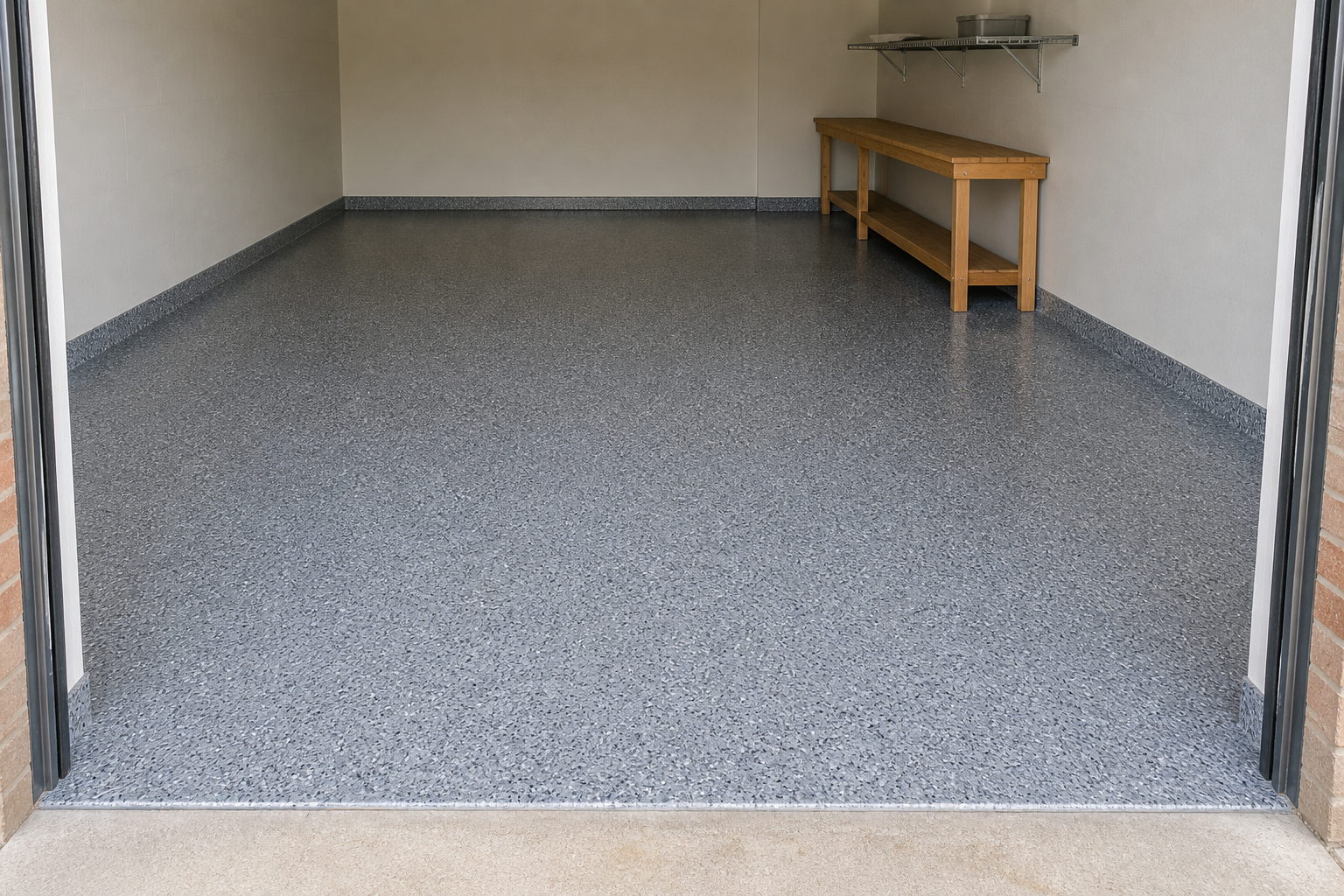
Professionally installed epoxy flooring in Sydney runs roughly $50 to $150 per square metre, with most residential garage projects landing in the $80 to $120 band once a flake system and standard preparation are included.
The spread is wide because epoxy is not one product. A basic single-coat seal and a multi-coat metallic system are different jobs, and the concrete underneath decides how much work happens before either goes down.
What Actually Sets the Price
- The system, not the square metres. Basic, flake, heavy-duty and metallic systems have genuinely different material and application costs.
- Preparation can be the largest line. Grinding, crack repair, contamination removal and old coating removal all sit before the epoxy.
- Moisture is the deal-breaker. Excessive moisture in a slab causes coatings to debond, and it needs testing rather than assuming.
- A low rate can be the expensive quote. A $60 rate that excludes preparation often finishes higher than an $85 rate that includes grinding, primer and topcoat.
- Small garages pay proportionally more. Equipment, transport and setup do not scale down with floor area.
- DIY kits are cheap in materials and expensive in everything else. Grinder hire, dust extraction and rework are the real comparison.
How Much Does Epoxy Flooring Cost Per Square Metre?
Between roughly $50 and $150 per square metre installed, depending entirely on the system. Quoting a single average for epoxy is misleading, because the word covers everything from a thin sealer to a multi-coat decorative build-up.
Indicative epoxy flooring rates by system type
| System | Indicative rate per m² | Best suited to |
|---|---|---|
| Basic epoxy coating | $50 to $80 | Standard residential garages, light use |
| Heavy-duty epoxy | $50 to $90 | Workshops and high-traffic areas |
| Flake epoxy system | $80 to $120 | Decorative residential garage finishes |
| Multi-coat epoxy system | $90 to $140 | Higher durability requirements |
| Metallic epoxy | $100 to $150 and above | Decorative interiors and feature floors |
Indicative Australian market guidance for budgeting, not fixed 7CPM prices. Published cost guides use different scopes, so confirm whether preparation, primer, topcoat, labour and GST are included before comparing.
Most residential garages land in the flake system band, around $80 to $120 per square metre, because that is the specification that balances durability, appearance and the ability to hide minor slab imperfections.
A lower rate on paper does not mean a cheaper floor. A flake system quoted at $85 per square metre with grinding, primer and a topcoat included can finish well below a $60 quote that adds preparation as a separate line once the slab has been looked at. Compare the scope, not the rate.
How Does Garage Size Affect the Total?
Indicative project totals by garage size
| Garage type | Approximate area | Indicative total |
|---|---|---|
| Single garage | 18 to 20m² | $1,200 to $1,800 |
| Double garage | 36 to 40m² | $2,200 to $3,500 |
| Large garage or workshop | 45m² and above | Quote required |
Project-level market guidance for standard garage applications in reasonable condition. These are not a direct multiplication of the per-square-metre bands above.
Larger garages cost more in total and often less per square metre. A contractor loads and unloads the same grinder, extractor and materials whether the floor is 18m² or 40m², and travels to the site once either way. Those relatively fixed costs spread across a bigger area.
Beyond raw dimensions, the total is shaped by layout, existing coatings, cracks, oil contamination, moisture, drainage falls, equipment access and the number of coats specified.
What Additional Costs Should You Expect?
Preparation is not an optional extra and on some slabs it is the biggest single component. Epoxy bonds to properly prepared concrete. It does not bond to dust, oil, old sealer or a slab that is pushing moisture upward.
Potential preparation requirements and cost impact
| Preparation item | Why it may be needed | Cost impact |
|---|---|---|
| Concrete grinding | Creates the mechanical key the coating bonds to | Often included in the rate, extra where extensive |
| Crack repair | Cracks telegraph through a coating and keep moving | Quoted per crack or per metre |
| Oil and grease removal | Contaminants prevent adhesion at exactly the spots that matter | Quoted on inspection |
| Existing coating removal | Old paint or sealer has to come off for the new system to bond | Can be significant on a fully coated floor |
| Moisture testing | Establishes whether the slab is suitable before anything is applied | Modest, and cheap insurance |
| Moisture mitigation | A moisture barrier system where readings are too high | Product and site dependent, can be substantial |
Moisture is the failure mode nobody budgets for. Excessive moisture moving up through a concrete slab causes coatings to debond and deteriorate, and it does it months after the job looks finished. ASTM F2170 is the recognised test method for relative humidity in concrete floor slabs using in situ probes. On an older slab, a slab on ground with no vapour barrier, or any garage that has ever shown damp patches, testing before coating is the difference between a floor and a warranty claim.
Not every garage needs every item. A newer, uncoated, dry slab may need little more than a grind and a clean. An older garage with an oil-stained, previously painted, damp floor may need most of the list, which is why two similar-looking garages get very different quotes from the same contractor.
How Do Type and Thickness Affect the Price?
Price differences between quotes usually come down to specification rather than one contractor simply charging more for identical work.
Epoxy systems compared on durability, appearance and cost
| System | Durability | Appearance | Relative cost | Suited to |
|---|---|---|---|---|
| Basic epoxy | Moderate | Plain colour | Lowest | Light residential use |
| Flake system | High | Decorative, hides imperfections | Middle | Most residential garages |
| Heavy-duty system | High | Functional | Middle to high | Workshops and high traffic |
| Metallic epoxy | Varies with build | Premium decorative | Highest | Interior feature floors |
Thicker is not automatically better. The right system follows the substrate condition and how the garage is actually used. A light-use single garage on a sound slab suits a basic or flake system. A workshop with a trolley jack, dropped tools and solvent spills needs a heavier specification, and paying for a metallic finish in that room is money in the wrong place.
On slip resistance, new pedestrian surface materials are classified under AS 4586. Worth knowing: the National Construction Code’s slip-resistance provisions apply to stairways, landings and ramps rather than to a domestic garage slab, so this is a practical decision about how wet your garage gets rather than a compliance requirement. A non-slip additive is straightforward to specify where cars come in wet.
Is an Epoxy Garage Floor Worth the Cost?
Worth it when the slab is sound and you use the garage as a room rather than a shed. The practical gains are real: it stops concrete dusting, it cleans with a mop instead of a broom, oil wipes off instead of soaking in, and it makes the space feel finished.
- No more concrete dust once the slab is sealed, which is the change most people notice first
- Spills sit on the surface rather than staining into porous concrete
- A seamless floor with no grout lines or joints to collect dirt
- Resistance to common garage contaminants including oil, fuel and cleaning products
- A range of finishes from plain colour through flake to metallic
- Straightforward maintenance, mostly sweeping and prompt spill cleanup
Not worth it on a slab that needs fixing first. Badly cracked concrete, persistent moisture or a floor needing substantial repair changes the equation entirely, because those problems have to be solved before coating and they cost more than the coating does.
DIY Kit or Professional Installation?
The kit is cheap. The project might not be. Retail epoxy kits sit well below professional installation on materials alone. Bunnings, for example, lists a 4L Dy-Mark water-based epoxy garage floor kit at around $172, covering roughly 18 to 20m². Retail pricing changes, so check the current listing before budgeting from it.
DIY kit and professional installation compared
| Factor | DIY kit | Professional installation |
|---|---|---|
| Upfront material cost | Low | Higher, but includes everything |
| Preparation | Yours, including grinder and dust extraction hire | Included and machine-ground |
| Moisture testing | Rarely part of a kit | Can be assessed before committing |
| Crack and contamination repair | Yours to identify and fix | Assessed and quoted |
| Finish consistency | Depends on experience and pot life management | Generally consistent |
| Rework risk | Borne by you, and rework means grinding it off | Covered by the installer’s warranty |
The honest version: a dry, uncoated, sound slab in a single garage is a reasonable DIY candidate if you hire proper grinding gear and read the product data sheet. An older slab with an unknown coating history, damp patches or oil staining is where DIY projects go wrong, and grinding a failed epoxy floor back off is considerably more expensive than having it done once.
A Budgeting Calculation
Floor area × indicative system rate + preparation + repairs + finish extras
Worked example. An 18m² single garage with a flake system at $100 per square metre gives a base of $1,800. If that rate already includes standard grinding and preparation, the number stands. If it does not, add the preparation items the slab actually needs on inspection. Either way, ask which of the two you are looking at, because it is the most common reason quotes are not comparable.
Comparing Epoxy Quotes Properly
- The exact floor area being coated, including whether it runs under shelving
- Whether grinding and general preparation are included
- Whether crack repairs are included or itemised
- Whether moisture testing is included, or required
- The number of coats, and whether primer and topcoat are among them
- What decorative finish is included, and flake coverage rate if applicable
- Whether the price includes GST
- Cure time before you can park on it
- Warranty terms, and what is specifically excluded
7CPM provides epoxy floor coating across Sydney for garages, workshops and commercial floors. For the wider range of coating and painting work, see our services.
Frequently Asked Questions
How much does epoxy flooring cost in Sydney?
Roughly $50 to $150 per square metre installed, depending on the system. Basic coatings sit at the lower end, flake systems around $80 to $120, and metallic finishes at the top. Most residential garages land in the flake band. Preparation, concrete condition, moisture, access and project size all move the final figure, and these are indicative market ranges rather than fixed 7CPM prices.
What is the average cost of an epoxy garage floor?
An indicative single garage of 18 to 20 square metres runs about $1,200 to $1,800, and a double garage of 36 to 40 square metres about $2,200 to $3,500. These are project-level estimates for slabs in reasonable condition, not a direct multiplication of the per-square-metre rates, because smaller floors carry proportionally more of the fixed setup cost. A slab needing crack repair, coating removal or moisture mitigation sits above these ranges.
Does garage size affect epoxy flooring cost?
Yes, in both directions. A larger garage needs more material and labour, so the total is higher. But the fixed costs of loading equipment, travelling to site and setting up are much the same for a single or double garage, so those spread across a bigger area and the effective rate per square metre falls. This is why a double garage often works out cheaper per square metre than a single one.
Do you need to test concrete for moisture before epoxy?
On any slab where moisture is plausible, yes. Excessive moisture moving through concrete is a leading cause of coating debonding and deterioration, and it shows up months after installation rather than immediately. ASTM F2170 is the recognised in situ probe method for measuring relative humidity in concrete slabs. Older slabs, slabs on ground without a vapour barrier, and any garage that has shown damp patches are the ones worth testing before committing.
Is professional epoxy flooring more expensive than DIY?
Upfront, yes. A retail kit costs a fraction of a professional installation on materials. The comparison changes once you add grinder and dust extraction hire, crack repair, moisture assessment, your own time, and the risk of rework, since removing a failed epoxy coating means grinding it off. A dry, sound, uncoated slab is a reasonable DIY project. An older slab with unknown coating history is where the professional cost usually justifies itself.
Get a Price for Your Actual Slab
Tell us the garage size, roughly how old the concrete is and whether it has ever been coated or shown damp patches. That is most of what decides the number.
0468 814 249
or
request a free quote
Servicing Sydney wide, with no call out fee. See epoxy floor coating for garages, workshops and commercial floors.